

Delivery App Development: Courier and Last-Mile Guide
A delivery app coordinates three groups: customers or senders who book and track, riders or drivers who pick up and drop off, and a dispatcher who assigns and monitors work. For courier, parcel and last-mile logistics, assignment, live tracking and proof of delivery decide success, so the rider app and dispatch panel matter as much as the customer app.

Key takeaways
- Design the rider app and dispatch panel first; the customer app is the easy part and is useless if assignment and proof of delivery are weak.
- Physical deliveries must not be paid for through Apple in-app purchase or Google Play billing, so plan a payment gateway from the start.
- Start with simple proximity assignment in one zone, measure late and failed deliveries, and add batching or optimisation only once you have data to tune it.
On this page
A delivery app looks simple from the customer's side: book, track, receive. The work is on the other two sides, where a rider has to know what to pick up and where it goes, and a dispatcher has to see every job and fix the ones going wrong. That is why the useful way to plan a delivery app is as a small logistics system with three apps in it.
This guide covers courier, parcel, hyperlocal and B2B last-mile delivery. Restaurants and grocers have catalogue and menu problems of their own, covered in our guides to food delivery app development and grocery delivery app development; ride-hailing is in taxi app development.
The parts of a delivery system
| Part | Who uses it | Its core job |
|---|---|---|
| Customer or sender app (or web booking) | Individuals, shops, businesses | Book a pickup, see price and ETA, track, pay, rate |
| Rider or driver app | Couriers, riders, fleet drivers | Receive jobs, navigate, confirm pickup, record proof of delivery, log cash collected, handle returns |
| Dispatch and admin panel | Operations team | See every job on a live map, assign and reassign, manage zones and pricing, handle exceptions, pay riders, report |
| Integrations | The systems around it | Maps and routing, payments, SMS or WhatsApp, merchant stores and ERP, tax documents |
Which kind of delivery operation are you running?
The operating model decides most design questions, so settle it before listing features.
| Model | Typical example | What dominates the design |
|---|---|---|
| Hyperlocal on-demand | Same-hour pickup and drop within a city | Fast assignment, live tracking, rider availability |
| Scheduled parcel and courier | Next-day or multi-hub parcels | Manifests, hub scans, status checkpoints, delivery attempts |
| B2B and store delivery | A retailer or distributor's own fleet | Order imports, route plans, invoices, proof and returns |
| Marketplace of independent riders | An aggregator that onboards couriers or gig riders | Rider onboarding, ratings, payouts, compliance records |
Features that matter, and why
Order assignment and dispatch
Assignment logic is where a delivery product wins or loses. At minimum, offer automatic assignment by proximity and current load, manual override for the dispatcher, a timeout that reassigns an ignored job, and delivery zones. Poorly tuned assignment shows up as late deliveries long before anyone looks at a dashboard.
A rider app built for the road
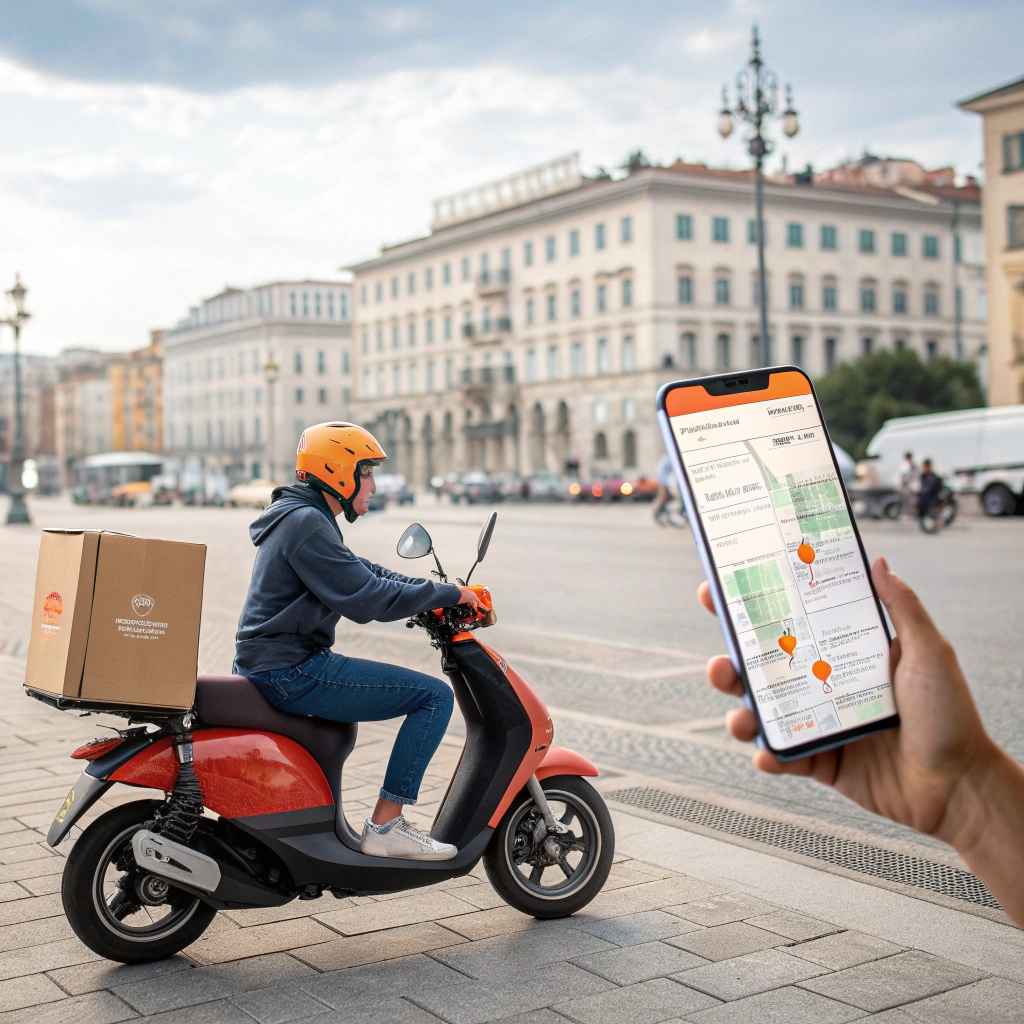
Treat the rider app as the main product. Riders use it one-handed and outdoors for a whole shift, so it needs large controls, careful battery use, one-tap navigation and customer calling. Proof of delivery comes through a photo, a customer OTP or a signature. Cash-on-delivery amounts should be recorded per order so they reconcile against deliveries, and returns or exchange pickups should live in the same app. Our RocketZone rider app case study shows this scope in a real build: real-time order assignment, Google Maps navigation, COD tracking, returns and exchange pickups, and delivery proof in one Android app.
Live tracking and ETAs
Customers expect a map and an arrival estimate. Decide how often the rider's location is sent, because frequent updates improve the map but cost battery, data and map-provider usage. Estimate arrival from a routing service rather than straight-line distance. Google Maps Platform's routing service, for example, supports two-wheeler routes, which matters for bike and scooter fleets. Show a "last updated" time so a stale position is not mistaken for a live one.
Pricing and payments
Price by distance, weight, zone or time slab, and keep the pricing table editable by the operations team without a release. Add payouts for riders and a clear flow for cash collected on delivery, because cash handling needs a clear audit trail.
Notifications and customer communication
Send status updates through push, SMS or WhatsApp at the moments people care about: assigned, picked up, near you, delivered, attempt failed. Let customers contact the rider without exchanging personal numbers.
Analytics and service levels
The dispatcher needs on-time rate, failed-delivery reasons, rider utilisation and cost per delivery, and alerts when a job is about to breach its promised window.
Rules and platform policies to design around
This reflects official sources as of October 2026 and is not legal advice.
- Payments in the app stores. Apple's guideline 3.1.3(e) says apps selling physical goods or services consumed outside the app must collect payment by methods other than in-app purchase. Google Play's payments policy says its billing system must not be used for physical goods or physical services, including food delivery and transportation. Use a payment gateway, not store billing.
- Rider location. Google Play allows background location only when it is relevant to the app's core functionality and requires a permission declaration, and it may reject apps without adequate justification. Google's rules for foreground services say they should start from a user-initiated action and end when the task is done, so tie tracking to the rider going online or starting a job, and stop it when the shift ends.
- E-way bills for B2B goods. CBIC's FAQs describe an e-way bill as the document carried with a consignment of goods valued above ₹50,000, and say the e-way bill system supports API integration with a registered person's own software. A B2B logistics app can integrate with it rather than rekey data. Confirm the current threshold and rules before you build.
- Gig and platform workers. The Code on Social Security, 2020 took effect with the other labour codes on 21 November 2025. It defines aggregators and requires them to contribute 1–2% of annual turnover, capped at 5% of what they pay or owe gig and platform workers, to a social security fund. Whether your business is an aggregator is a legal question; keep clean per-rider activity and payout records either way.
- Personal data. Addresses, phone numbers and live location are personal data. The Digital Personal Data Protection Rules were notified in November 2025 with an 18-month phased compliance timeline, so build consent and retention rules in from the start.
How a delivery app build runs
- Define the operation: zones, volumes, promised delivery windows and whether riders are employed, contracted or gig.
- Design the rider and dispatcher flows first, and test them with real riders.
- Build the backend: the order lifecycle, assignment, tracking and notifications, then the three front ends on top.
- Integrate maps, payments, messaging and the systems that send you orders.
- Field-test with a small fleet in one zone, measuring assignment time and failed deliveries.
- Roll out zone by zone, with monitoring and a support routine for riders.
What drives cost and timeline
- How many apps and panels you build, and whether one codebase serves several roles.
- Assignment sophistication: manual only, automatic by proximity, or batching and optimisation.
- Tracking intensity, which drives both engineering and map-provider usage. Google Maps Platform, for example, offers subscription and pay-as-you-go pricing, so check the plan against your expected volume.
- Payment and COD reconciliation, rider payouts and refunds.
- Integrations: merchant stores, ERP, courier or aggregator APIs, tax documents.
- Scale: concurrent riders and orders at peak.
- Operations tooling: exception handling, reporting and rider onboarding.
Risks and trade-offs
- Build or adapt. If your process is standard, a configurable dispatch product may be enough. Custom development pays off when your assignment rules, pricing or integrations are what set you apart.
- Rider adoption. A slow or battery-hungry rider app means riders stop using it, and tracking and proof of delivery stop with it. Test on the phones your riders actually own.
- Location quality. GPS drifts in dense areas and indoors. Smooth the position on the map, and do not trigger penalties from a single odd reading.
- Fraud and leakage. False delivery confirmations and uncollected cash are risks to design for. Counter them with OTP or photo proof, location checks at the drop point and daily COD reconciliation.
Choosing a development partner
Ask each shortlisted team:
- Which rider-facing or dispatch apps have they shipped, and can they show one working?
- How would they design assignment, and how would they measure whether it works?
- How do they handle background location, battery use and weak connectivity?
- How do they manage store policies on payments and location?
- Who owns the source code, accounts and data at handover?
- What support do they offer during the first weeks of rollout?
How Mindrops works on delivery apps
Mindrops builds logistics software covering fleet and dispatch, real-time tracking, route optimisation and analytics, with integrations to ERP, e-commerce and third-party systems; see our logistics app development service and logistics and mobility work. Mobile apps use Flutter, React Native or native Kotlin, with Node.js or Python backends, PostgreSQL, Redis, WebSockets and map APIs. A project moves through discovery, design, build and release, and the client owns the source code, documentation and infrastructure configuration. The RocketZone rider app, designed, built and deployed by Mindrops between January and June 2026, is our published delivery work. New enquiries get a quick reply.
Conclusion
A delivery app is judged by whether a parcel arrives on time and the operations team knows where it is. Define the operating model, build the rider app and dispatch panel as the core, and keep assignment simple until you have data. If you are planning one, get a quote and tell us how your deliveries run today.