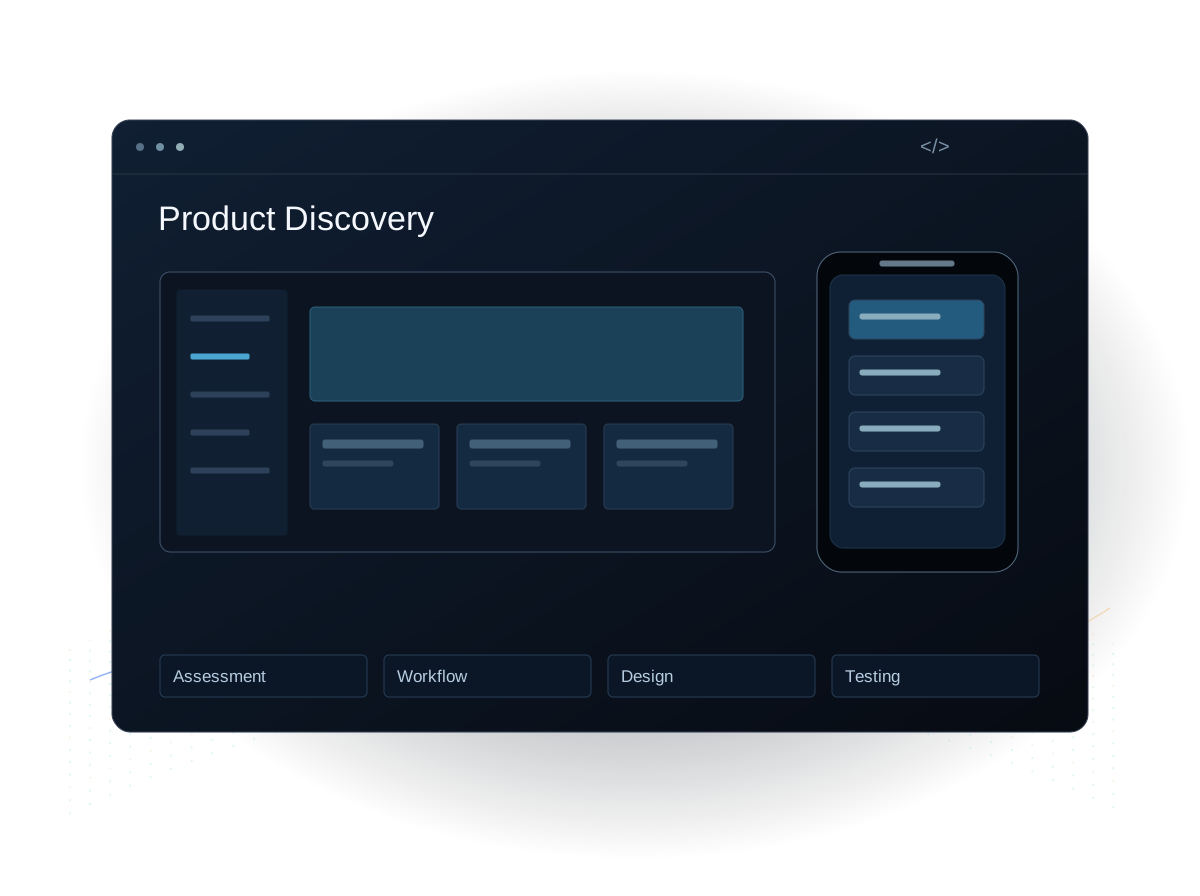
Product discovery that produces a tested scope, estimate and roadmap.
Mindrops runs a short, structured discovery phase that turns an idea or a problem into a validated, buildable plan — tested with real users, checked by engineers and estimated in writing before production code is written.
A selection of the software Mindrops has designed and engineered for clients.
Extraction accuracy99%with human-in-the-loop review, on tens of thousands of documents a monthUK accountancy
AI · Accounting
Caelum AI — Document Processing
A Mindrops document-intelligence product that extracts transactions, line items, totals and dates to Excel, CSV, JSON or XML through a REST API, with human-in-the-loop review.
Delivers 99% extraction accuracy on supported documents across bank statements, invoices and receipts.
A dedicated onshore and offshore Mindrops team built, upgraded and maintained the platform with Agile delivery — campaign matching, messaging and real-time reporting.
Maintained for 4+ years, scaling to 130,000+ influencers and 100,000+ brands on a network serving 16M+ users a month.
Cafés in India50+outlets across India, served by the systems we builtBrewing since 1963
AI · Food & Beverage
BeanBot — The Coffee Bean & Tea Leaf
An embeddable AI chat assistant grounded in live catalogue and store data, with an “Order Now” action on every product and a no-code admin console for content and pricing.
Live across 50+ outlets in India, handling about 10,000 conversations a month and around 50 orders a day.
Product discovery is a short, structured phase before a build that turns an idea or problem into a validated plan. Mindrops interviews stakeholders and users, frames the problem, defines a prioritised MVP, tests a clickable prototype with users and runs a technical feasibility spike, then hands over a risk register, a written estimate and a roadmap.
01
Stakeholder & user interviews
Structured conversations with sponsors, operators and end users that surface goals, constraints and how the work really happens today.
02
Problem framing & journey maps
A written problem statement, agreed success measures and current- and future-state journeys showing where value and friction sit.
03
Prioritised scope & MVP
A ranked backlog and a defined first release, including what is deliberately left out and why.
04
Clickable prototype & usability tests
Key flows prototyped in Figma and put in front of real users, so the riskiest assumptions are tested before any code.
05
Feasibility spike & architecture
Engineers test the hardest integration, data or AI question in throwaway code and outline the target architecture.
06
Risk register, estimate & roadmap
Named risks with mitigations, a written estimate and a phased delivery roadmap your decision-makers can act on.
Who product discovery is for
Founders protecting a first budget
Start-ups that want their riskiest assumptions tested and the MVP cut to essentials before paying for a full build.
Enterprises preparing a business case
Product and innovation leads who need user evidence, a scoped first release and a written estimate to take to an investment committee.
Teams with competing requirements
Organisations where departments disagree on what a system must do, and a long wish list has to become a defensible order of work.
Buyers who need a specification first
Public bodies and procurement teams that need a clear, tested scope so quotes and tenders are priced against the same thing.
Why Mindrops for product discovery
Engineers in the room from day one
Senior engineers join the interviews and workshops, so every scope decision is weighed against integration effort, data quality and security before it reaches the estimate.
Assumptions tested with users
The flows that carry the most risk are prototyped and tried by real users, and the hardest technical question gets a working spike.
Experience from our own products
Mindrops builds and runs its own SaaS, including Caelum AI, so deciding what a first release can leave out is a call we also make on our own roadmap.
Recommendations you can trace
Each recommendation points back to an interview, a test result or a spike finding, and the estimate lists its assumptions so you can see what would move it.
Technologies we use
Research & framing
Stakeholder interviews · User interviews · Journey maps · Jobs to be done
iPhone and Android apps for selling a used phone in Delhi, from choosing the model and answering condition questions to price, pickup booking and payment.
From the client’s review
“Instead of building our first list as it was, the Mindrops team tested it, found it too long and cut it down until a new user could finish it easily.”
Customer, restaurant-partner and rider apps, an admin panel and a marketing website for a pure-vegetarian delivery service, built from scratch.
From the client’s review
“The customer app, restaurant app, and rider app all feel like they belong to the same ecosystem rather than being built separately and assembled later.”
One platform replacing scattered tools for pet food ordering, walker bookings, vet consultations and adoption listings, with customer features and a vendor management backend.
From the client’s review
“The vendor and admin management setup stood out most, since it needed to handle walkers, trainers, cafés, and diagnostic labs within one consistent system.”
A mobile app, website and admin dashboard connecting patients in rural and semi-urban India with doctors, with video consultations, digital prescriptions and patient registration.
From the client’s review
“The UI/UX design process was collaborative and they kept the end user in mind throughout, which mattered a lot for a platform targeting rural users.”
A short, structured phase before a build that turns an idea or problem into a validated, buildable plan. It combines stakeholder and user research, problem framing, MVP scoping, prototype testing and a technical feasibility check, and ends with a written estimate and roadmap.
How is product discovery different from UI/UX design?
Discovery decides what to build and whether it can be built, using quick prototypes to test ideas. UI/UX design then produces the finished interfaces, high-fidelity UI and design system for the agreed scope.
What happens after discovery?
If you go ahead, the build starts from the discovery outputs — validated scope, architecture and estimate — with product engineering. If the evidence says not to build, you learn that before spending the build budget.
How long does discovery take, and how is it priced?
It depends on the size of the product, the number of user groups and how many technical questions need a spike. The discovery is scoped with you before it starts, and the build estimate it produces can run on the engagement model that fits — see engagement models.
Is discovery only for new products?
No. It also suits replacing or extending an existing system: we study the current platform, its users and its data, then plan the change. For organisation-wide programmes, see digital transformation consulting.
Who needs to take part from our side?
A sponsor who can make scope decisions, a few representative users from each user group, and the owners of any systems the product must connect to.
Contact us
Tell us the idea or the problem, who it is for and what you need to decide. We’ll reply within one business day to scope the discovery.