



DPDP Compliance Checklist for Indian Businesses
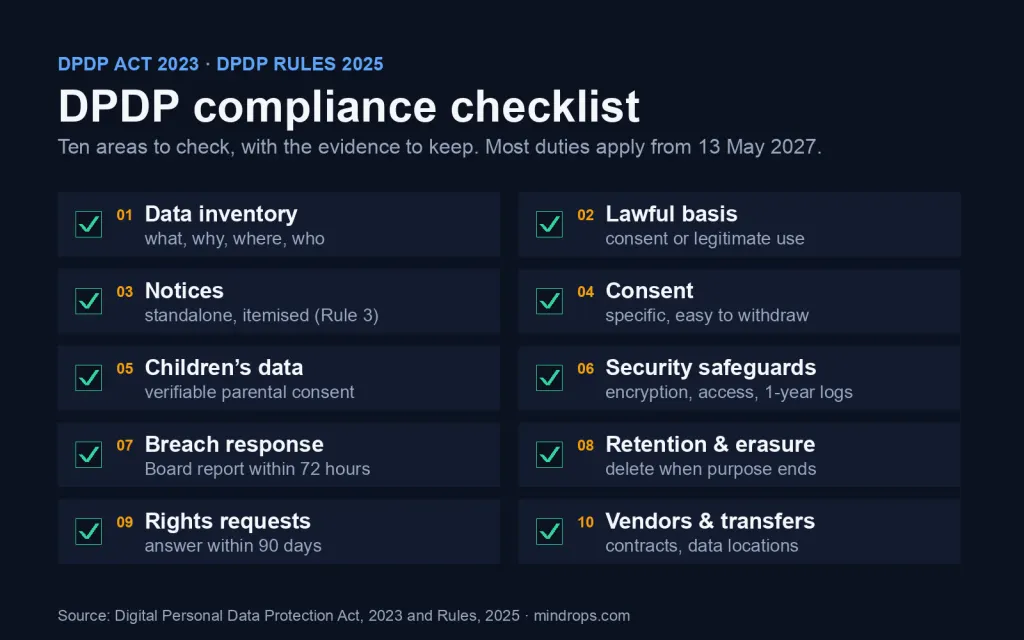
A DPDP compliance checklist covers ten areas: a data inventory, lawful basis, notices, consent, children's data, security safeguards, breach response, retention and erasure, data-principal rights and vendor contracts. Significant Data Fiduciaries add a DPO, a yearly DPIA and an audit. Most of these duties apply from 13 May 2027.
Want this checklist run against your systems? Get a quote

Key takeaways
- Start with a data inventory. Every other check depends on knowing what personal data you hold, why, where and who touches it.
- Consent must be specific to each purpose, limited to the data that purpose needs and as easy to withdraw as to give.
- You stay responsible for what your vendors do with personal data, so processor contracts and deletion are part of the checklist.
- Keep evidence as you go: notices, consent records, logs, breach drills, request registers and contracts are what you would show the Data Protection Board.
- Customers who gave consent before the Act still need a notice describing their data and its purpose, as soon as reasonably practicable.
On this page
This checklist is for the people who have to make DPDP compliance happen: founders, CTOs, heads of compliance and IT managers. Each section lists what to check, the evidence to keep and where the duty comes from in the Digital Personal Data Protection Act, 2023 and the DPDP Rules, 2025.
For when each duty starts, see our DPDP Rules 2025 timeline. In short, most of what follows applies from 13 May 2027.
How to use this checklist
Work through it once as a gap assessment: mark each item as done, partly done or not started, and name an owner. Then treat the evidence column as your audit file. If the Data Protection Board ever asks what you did, records are what you will show.
A few terms used below:
- Data fiduciary: the organisation that decides why and how personal data is processed. That is usually you.
- Data processor: a vendor that processes personal data on your behalf, such as a cloud host, CRM, payroll provider or call centre.
- Data principal: the person the data is about. For a child, this includes the parent.
1. Data inventory and mapping
Every other check depends on this one.
- List every type of personal data you collect: customers, leads, employees, job applicants, vendors' staff and website visitors.
- For each type, record the purpose, the source, the systems that store it, who can access it and how long you keep it.
- List every vendor that receives personal data, and anything stored or accessed outside India.
- Flag children's data and data about persons with disabilities.
- Note paper records that are later scanned or typed in. The Act covers data collected in digital form and data digitised later.
Evidence: a data inventory or record of processing, and data-flow diagrams for the main systems.
2. Lawful basis for every purpose
The Act allows processing only for a lawful purpose, with the person's consent or for a "legitimate use" listed in section 7. Examples are data a person gave voluntarily for a specific purpose, employment, and legal obligations.
- For each purpose in the inventory, record whether it relies on consent or on a specific legitimate use.
- Stop collecting data that no purpose needs.
- Remove "just in case" fields from forms.
Evidence: the lawful basis recorded against each purpose in the inventory.
3. Notices
Rule 3 sets what a notice must contain. It applies from 13 May 2027.
- Each consent request comes with a notice that can be understood on its own, without reading another document.
- The notice gives an itemised list of the personal data and the specific purpose: the goods, services or uses it enables.
- It explains how to withdraw consent, how to exercise rights and how to complain to the Data Protection Board, with a link to your website or app.
- People can read it in English or in any language in the Eighth Schedule to the Constitution.
- Customers who consented before the Act get a notice describing their data and its purpose as soon as reasonably practicable (section 5(2)).
Evidence: current versions of each notice, with dates, and records of notices sent to existing customers.
4. Consent capture and withdrawal
Section 6 says consent must be free, specific, informed, unconditional and unambiguous, given by a clear affirmative action.
- No pre-ticked boxes, and no bundling of unrelated purposes into one "I agree".
- Consent is limited to the data each purpose needs. The Act's own example is a telemedicine app that has no need for the user's contact list.
- Each consent is recorded: who, what, when, which notice version and how.
- Withdrawing consent is as easy as giving it, for example a one-click unsubscribe or an in-app toggle.
- On withdrawal, you and your processors stop processing within a reasonable time, unless a law requires or allows it.
- Your systems can accept consent given or withdrawn through a registered consent manager.
Evidence: consent logs, screenshots of consent flows and the withdrawal process.
5. Children and persons with disabilities
Under the Act, a child is anyone under 18.
- Find out whether children use your product or whether you hold their data, for example in schools, edtech, gaming, healthcare or family accounts.
- Get verifiable consent from a parent before processing a child's data. Rule 10 says to confirm that the parent is an identifiable adult, using identity details you already hold or a virtual token from an authorised entity, such as a government-backed identity service.
- Do no tracking, behavioural monitoring or targeted advertising directed at children (section 9(3)), unless an exemption in the Rules applies.
- For a person with a disability who has a lawful guardian, get consent from the guardian and verify the guardianship.
- Check whether an exemption applies to you: healthcare providers, educational institutions, crèches and school transport each have conditions.
Evidence: age-gating and parental-consent flows, verification records and exemption analysis.
6. Security safeguards
Rule 6 sets the minimum. Failing here carries the Act's highest penalty, up to ₹250 crore.
- Personal data is encrypted, masked, obfuscated or tokenised where appropriate.
- Access is limited to people who need it, with access reviews.
- Logs and monitoring can detect unauthorised access and support an investigation.
- Backups let processing continue after an incident.
- Logs and the related personal data are kept for one year for investigation, unless another law says otherwise.
- Contracts make your processors take reasonable security safeguards.
- Safeguards are tested, for example with vulnerability assessment and penetration testing.
Evidence: security policy, access reviews, log retention settings, backup tests and penetration test reports.
7. Breach response
Rule 7 and section 8(6) set the steps.
- A written breach-response plan names who decides, who investigates, who informs the Board and who informs customers.
- Affected people are told without delay, in plain language: what happened, the likely consequences, what you are doing, what they can do and whom to contact.
- The Board is told without delay, then sent a detailed report within 72 hours of your becoming aware of the breach.
- Templates for both are ready in advance.
- Processors must tell you about breaches quickly enough for you to meet these deadlines.
- The plan is tested with a simulated incident.
Evidence: the plan, templates, drill reports and a breach register.
8. Retention and erasure
Sections 8(7) and 8(8), with Rule 8, set the rules.
- Each purpose has a retention period, and data is erased when the purpose is served or consent is withdrawn, unless a law requires you to keep it.
- Processors erase the data you gave them when you erase it.
- Processing logs are kept for at least one year, then erased unless a law needs them longer.
- Large platforms erase inactive users' data after three years, with at least 48 hours' warning first. This covers e-commerce and social media platforms with at least 2 crore registered users in India, and online gaming platforms with at least 50 lakh.
Evidence: a retention schedule, deletion jobs or logs, and processor deletion confirmations.
9. Data-principal rights and grievances
Sections 11 to 14 and Rule 14 apply.
- Your website or app explains how to make a request and which details you need to identify the person.
- You can provide a summary of the person's data and processing, and a list of the fiduciaries and processors you shared it with.
- You can correct, complete, update and erase data on request, unless retention is needed for the purpose or a law.
- People can nominate someone to exercise their rights.
- A grievance process answers within a reasonable period, no longer than 90 days.
- The business contact of your DPO, or of a person who can answer questions about processing, is published and included in every response (Rule 9).
Evidence: a request and grievance register with response times, and the published contact page.
10. Vendors and transfers outside India
Section 8 makes you responsible for processing done on your behalf.
- Every processor works under a valid contract.
- Contracts cover security safeguards, breach notice, one-year log retention, deletion and help with rights requests.
- You know where each vendor stores and accesses the data.
- Transfers outside India meet any restriction the government notifies under section 16, and any requirement set under Rule 15.
Evidence: signed contracts or addenda, a vendor list with data locations, and vendor assessments.
Extra checks for Significant Data Fiduciaries
These apply only if the government notifies you, or a class you belong to, as a Significant Data Fiduciary.
- A Data Protection Officer based in India, answerable to the board and the point of contact for grievances.
- An independent data auditor.
- A Data Protection Impact Assessment and an audit every 12 months, with significant observations reported to the Board.
- Due diligence that algorithmic software does not put people's rights at risk.
- Personal data specified by the government kept in India.
Governance that holds it together
- One accountable owner, with named owners for each area above.
- A short policy set: data protection, retention, breach response, rights requests and vendor management.
- Training for the staff who handle personal data, including support, sales, HR and developers.
- A review at least once a year, and whenever you launch a product, add a vendor or change how data flows.
Where to start
If you have six months, spend the first month on sections 1 and 2. The inventory tells you which of the other eight sections matter most for your business. Notices, consent flows and rights handling need product and engineering time. Vendor contracts need negotiation. Those three are the ones to start next.
Mindrops runs DPDP gap assessments against this checklist and then builds what is missing: consent and rights workflows, security controls and logging, breach playbooks, training and DPO support. See DPDP Act compliance services. Legal opinions come from our legal partner or your own counsel. Security testing is covered by our VAPT services.