



DPDP Rules 2025: What to Do and By When
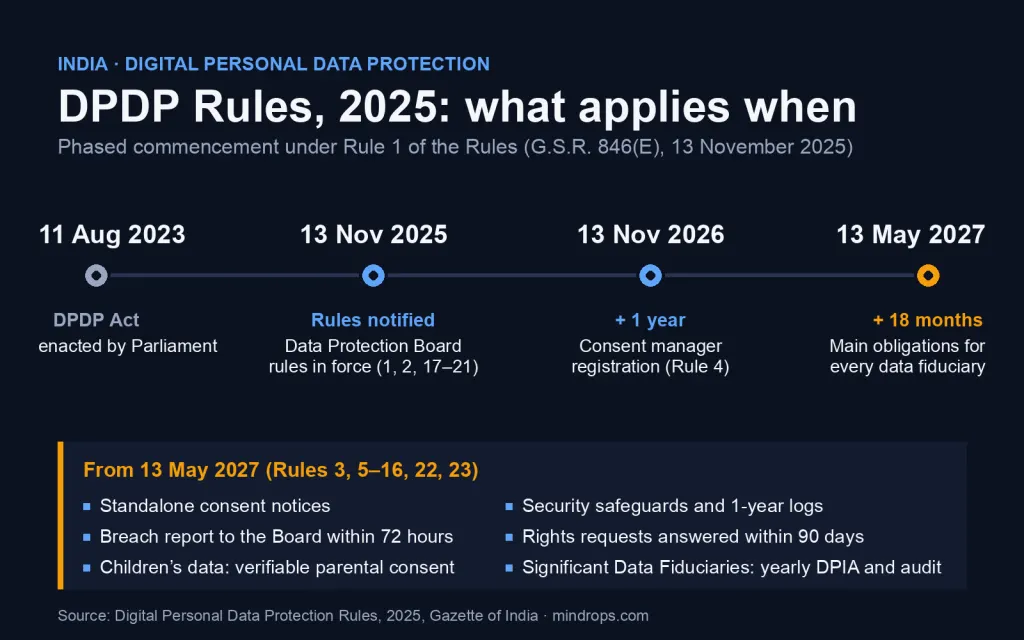
The DPDP Rules, 2025 were notified on 13 November 2025 and apply in three stages. The Data Protection Board rules applied at once. Consent manager registration began on 13 November 2026. The main duties for every data fiduciary, including notices, security safeguards, breach reporting, retention and data-principal rights, apply from 13 May 2027.
Need a DPDP plan before May 2027? Get a quote

Key takeaways
- 13 May 2027 is the date that matters for most organisations: notices, security safeguards, breach reporting, retention, children's data, rights requests and Significant Data Fiduciary duties all start then.
- A personal data breach must be reported to the Data Protection Board without delay, with a detailed report within 72 hours, and to every affected person without delay.
- Logs of personal data processing must be kept for at least one year, so logging has to be running well before May 2027.
- A proposal to shorten the 18-month window was reported in January 2026 but has not been notified. Plan for May 2027 and keep a buffer.
- Roughly six months remain. A gap assessment now leaves time for the slower work: consent flows, rights workflows, vendor contracts and logging.
On this page
This guide is for founders, CTOs and compliance leads who need the DPDP Rules 2025 timeline in one place, with what each date asks of them. All dates and duties are taken from the Rules as published in the Gazette of India and from the Digital Personal Data Protection Act, 2023.
The DPDP Rules 2025 timeline at a glance
The Rules' first rule sets their commencement. Everything else follows from the publication date, 13 November 2025.
| Date | What applies | Rules | Who has to act |
|---|---|---|---|
| 11 August 2023 | DPDP Act enacted by Parliament | — | Nobody yet: the Act waited for its Rules |
| 13 November 2025 | Definitions and the Data Protection Board | 1, 2, 17–21 | The government and the Board |
| 13 November 2026 | Registration and duties of consent managers | 4 | Companies that want to become consent managers |
| 13 May 2027 | Notices, security, breach reporting, retention, children's data, rights, Significant Data Fiduciary duties, cross-border transfers, appeals | 3, 5–16, 22, 23 | Every data fiduciary, and its processors through contracts |
The government announced the Rules in a press release on 14 November 2025. The Gazette notification itself, G.S.R. 846(E), is dated 13 November 2025, and later government statements use that date.
13 November 2025: the Board was set up
Rules 17 to 21 cover the Data Protection Board of India: how its chairperson and members are appointed, their terms of service, how it holds meetings and how it works as a digital office. Complaints are filed and tracked online. Appeals against the Board's decisions go to the Telecom Disputes Settlement and Appellate Tribunal (TDSAT).
For most organisations this stage required no action. It matters because the body that will receive breach reports and hear complaints now exists.
13 November 2026: consent managers can register
Rule 4 took effect a year after publication. A consent manager is a platform through which people can give, manage, review and withdraw their consent across many organisations. To register with the Board, an applicant must be a company incorporated in India with a net worth of at least ₹2 crore, among other conditions in the First Schedule of the Rules.
You do not have to become a consent manager or use one. You should plan for customers who give or withdraw consent through one, so that your consent records can take that input.
13 May 2027: the main obligations begin
Eighteen months after publication, the Rules that affect day-to-day operations take effect. These are the duties that need the most preparation.
Notices that stand on their own (Rule 3)
Each notice must be understandable without reference to any other document. It must give an itemised description of the personal data, the specific purpose and the goods, services or uses it enables. It must also explain how a person can withdraw consent, exercise their rights and complain to the Board. Withdrawing consent must be as easy as giving it.
In practice, a link to a long privacy policy is not enough. Most sign-up, onboarding and lead forms will need new consent screens and records.
Reasonable security safeguards (Rule 6)
The minimum list includes:
- encryption, masking, obfuscation or tokenisation of personal data
- access control on the systems that hold it
- logs, monitoring and review that can detect and investigate unauthorised access
- backups, so processing can continue after an incident
- retention of those logs and data for one year, unless another law requires otherwise
- security clauses in contracts with data processors
The ₹250 crore maximum penalty, the highest in the Act, applies to failures here.
Breach reporting (Rule 7)
When you become aware of a personal data breach, you must:
- tell each affected person without delay, in plain language: what happened, the likely consequences, what you are doing, what they can do and whom to contact
- tell the Data Protection Board without delay, with a description of the breach and its likely impact
- send the Board a detailed report within 72 hours: the facts, the cause, mitigation, any findings about who caused it, measures to prevent a repeat and a report on the notices sent to affected people
The Board can allow more time on a written request. Not reporting a breach can attract a penalty of up to ₹200 crore.
Retention, erasure and logs (Rule 8)
Every data fiduciary must keep personal data, traffic data and processing logs for at least one year from the date of processing, then erase them unless another law requires longer. This applies to your processors as well. The Rules give the example of a company whose cloud provider hosts its customer records: the company must make sure the provider also keeps the logs for a year.
Three classes of large platform must also erase a user's data after three years without any contact from that user, with at least 48 hours' warning before the data is erased:
- e-commerce entities with at least 2 crore registered users in India
- online gaming intermediaries with at least 50 lakh registered users
- social media intermediaries with at least 2 crore registered users
A named contact (Rule 9)
Every data fiduciary must publish, on its website or app, the business contact details of its Data Protection Officer if it has one, or of a person who can answer questions about its processing. The same contact must appear in every reply to a rights request.
Children and persons with disabilities (Rules 10 to 12)
Before processing a child's personal data, you need verifiable consent from a parent. The Rules describe how to check that the parent is an identifiable adult. Some processing is exempt, for example by healthcare and educational institutions and for real-time safety. For a person with a disability who cannot take legal decisions even with support, consent comes from a verified lawful guardian.
Significant Data Fiduciaries (Rule 13)
The government can notify an organisation as a Significant Data Fiduciary based on the volume and sensitivity of the data it processes and the risk to people. Once notified, it must:
- run a Data Protection Impact Assessment (DPIA) and an audit every 12 months and send the Board a report of significant observations
- check that its algorithmic software is not likely to put people's rights at risk
- keep specified personal data in India, where the government directs it
- under the Act, appoint a Data Protection Officer based in India and an independent data auditor
Rights requests within 90 days (Rule 14)
You must publish how people can make requests to access, correct, update or erase their data, and what identifiers you need to verify them. Requests and grievances must be answered within a reasonable period not exceeding 90 days. People can also nominate someone to exercise their rights for them.
Other rules starting in May 2027
- Rule 5: processing by the state for subsidies, benefits, licences and certificates.
- Rule 15: transfers outside India are allowed, subject to requirements the government may set for data made available to a foreign state or its agencies.
- Rule 16: exemption for research, archiving and statistics, if listed standards are met.
- Rules 22 and 23: appeals to TDSAT, and the government's power to call for information from a data fiduciary or intermediary.
Could the May 2027 deadline move earlier?
In January 2026, Business Standard reported that the Ministry of Electronics and Information Technology (MeitY) might cut the window for key rules from 18 months to 12. As of mid-November 2026, no amending notification had been published. On 5 August 2026, the government told the Lok Sabha that the Rules provide for phased implementation over an eighteen-month transition period.
Treat 13 May 2027 as the legal deadline, but plan to finish early. If the date does move, organisations that have already started will be the ones least affected.
Penalties under the Act
| Failure | Maximum penalty |
|---|---|
| Not taking reasonable security safeguards to prevent a breach | ₹250 crore |
| Not notifying the Board or affected people of a breach | ₹200 crore |
| Breaking the additional obligations for children's data | ₹200 crore |
| Breaking the additional obligations of a Significant Data Fiduciary | ₹150 crore |
| Any other breach of the Act or Rules by a data fiduciary | ₹50 crore |
The Board sets the amount in each case. It considers the nature, gravity and duration of the breach, among other factors.
What to do between now and 13 May 2027
About six months remain. That is enough time if the slow parts start now. An illustrative plan:
- November to December 2026: map and assess. List the personal data you hold, where it comes from, where it is stored, who can access it and which vendors process it. Then run a DPDP gap assessment against the Act and the Rules; our DPDP compliance checklist lists the checks. Find out whether you are likely to be notified as a Significant Data Fiduciary.
- January to February 2027: redesign consent and rights handling. Write standalone notices. Rebuild consent capture and withdrawal, add parental consent where children may use your service, and set up a way to receive and track access, correction and erasure requests within 90 days.
- February to March 2027: fix the contracts. Add security, retention, breach-notice and deletion clauses to processor agreements.
- March to April 2027: harden security and logging. Add encryption or masking, access control, monitoring, backups and one-year log retention. Write a breach-response playbook that can meet the 72-hour report, and test it with a simulated incident.
- April to May 2027: go live. Publish your contact person or DPO and the rights-request process, train the teams who handle personal data, and keep evidence of what you did.
Mindrops supports organisations through this work, from the gap assessment and DPIA to consent and rights workflows, security controls, training and DPO support. See DPDP Act compliance services. Legal opinions come from our legal partner or your own counsel. If you already run an ISO 27001 or other compliance programme, our compliance and GRC team can map DPDP onto it, and VAPT can test the safeguards before May 2027.